In 1986, designer Ken Cato was given less than a week to create a symbol that would help Australians spot locally made products. The result, a gold kangaroo inside a green triangle, has barely changed since. This year the Australian Made logo turns 40, and new figures from the Australian Made Campaign show it still carries real weight when shoppers decide what to buy.
For grocery and liquor retailers, that raises a practical question: when your customers shop online, can they see it?
Forty years on, the kangaroo still influences what Australians buy
According to the Australian Made Campaign's anniversary announcement:
- 99% of Australians recognise the logo
- 85% are more likely to choose a product that displays it
- 9 in 10 are confident that products carrying it are genuinely Australian
- It holds a consumer Net Trust Score of +82, placing it among Australia's most trusted brands
Roy Morgan research cited by the campaign also found that 89% of Australians believe buying Australian products is important.
Cato has said the project taught him to never ignore the obvious and "just make the obvious visible." Four decades later, that's still the job the kangaroo does.
In grocery, the kangaroo lives on the country of origin label
On food, the kangaroo is part of the country of origin label rather than the standalone Australian Made logo. In 2016, the Australian Government incorporated the kangaroo logo into a new country of origin label, which then became mandatory for most Australian food products. The current system came into full effect in July 2018. Food sold within Australia doesn't use the Australian Made logo as a standalone symbol and doesn't need to be licensed with the Australian Made Campaign.
The label comes in three styles:
- Three-part mark: kangaroo, bar chart and text. It's mandatory for certain food grown, produced or made in Australia, for example "Made in Australia from at least 50% Australian ingredients".
- Two-part mark: bar chart and text, no kangaroo. It's mandatory for certain food packed in Australia, and can also be used for imported food that contains Australian ingredients. Food imported and packed here without being substantially transformed can't carry the kangaroo, even if some Australian food is in the package.
- Statement: text only, such as "Made in Italy" or "Product of Brazil". It's used for non-priority foods, and imported priority foods must carry at least a statement in a clearly defined box.
A note for liquor retailers: alcoholic drinks are one of seven non-priority food categories under the standard, alongside seasonings, confectionery, biscuits and snack foods, soft drinks and sports drinks, tea and coffee, and bottled water. Non-priority foods only need a text statement, though producers can choose to use the full label as long as they follow the standard's rules.
What the rules say about selling online
The standard covers food sold online as well as in store, and the ACCC's business guide explains what that means:
- For packaged food, an online sale complies if the product's packaging carries the correct label.
- For unpackaged meat, fish, fruit and vegetables, the label can be on the delivered food, included with it (for example on a separate form), or visible online at the point of sale.
- Although the standard doesn't require labels on the webpages where food is sold, the ACCC encourages retailers to display the country of origin statement or standard mark on their websites.
In other words, showing the label online is mostly a service to your customers rather than a legal requirement, and for loose produce, meat and seafood it's one of the ways you can meet the rules.
How country of origin labels work on Myfoodlink
Country of origin labels are available to every Australian store on Myfoodlink. When a product has label details, it displays as a proper label: the kangaroo, a bar chart and the explanatory text, with a green border for standard marks and a black border for statements. The bar chart follows the same rounding rules set out in the standard.
The label appears in these places:
- The "Country of origin" section of your product pages
- Your Uber Eats export, which includes the kangaroo, bar chart and text
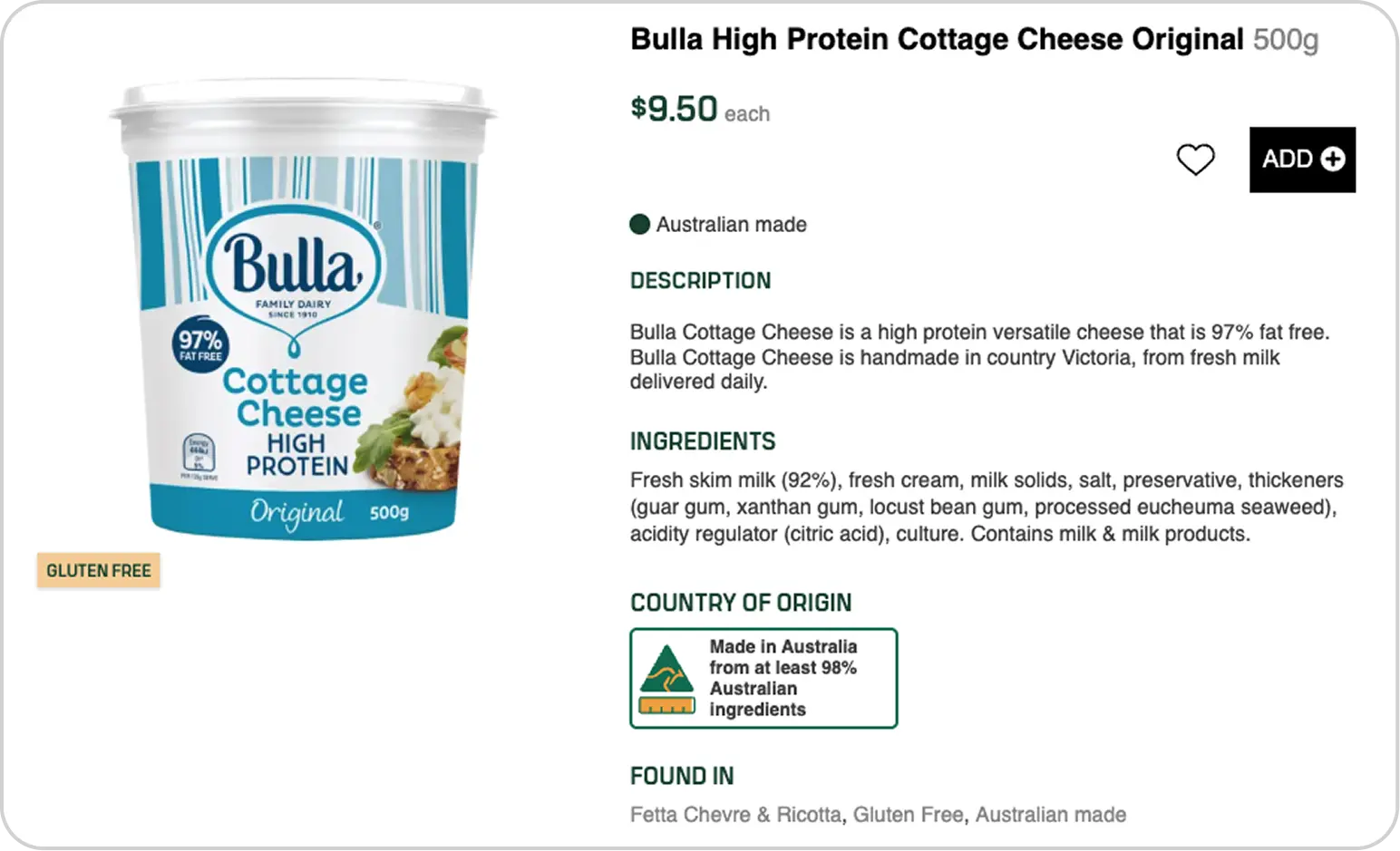
New Zealand stores use a single country of origin text field instead, displayed as "Product of…".
Two ways to add labels to your products
From your POS. Label details recorded in your POS can come through with your product imports if you use Worldsmart (Grocery Manager and Smart Retail), GaP Solutions, FutureNet, Profit Track, CSV import or Universal POS Import. Find out more about our POS integrations.
In the backoffice. Open a product's edit page, go to Origin Information and switch the toggle from POS to Human. Then choose whether to include the kangaroo, enter the bar chart percentage (0 to 100) and add the explanatory text. To update lots of products at once, go to Products, then Quick Edit, and select "Australian Country of Origin Labels". You'll need the "edit shared product info" permission to make changes.
A quick checklist for the anniversary
- Look up a handful of your best-selling Australian products online and check that the label shows
- If you use one of the POS systems above, check that label details are recorded for your products there
- Use Quick Edit to add labels to your top sellers, copying the label exactly as it appears on the pack
- For products you make or pack in store, the business.gov.au Country of origin labelling tool can help you work out which label applies. The ACCC's Country of origin food labelling guide covers the rules in detail
The kangaroo has spent 40 years making the obvious visible. It's worth a few minutes to make sure your online store does the same.
Questions about setting up labels for your store? Our support team can help.